


If you've worked in residential energy efficiency long enough, you've probably experienced this situation.
A home is modeled in one software platform and receives one result.
The same home is modeled in another platform and receives a different result.
The first people to notice are often the raters, energy consultants, and program implementers responsible for producing the analysis. Builders may experience the effects through changes in HERS or ERI scores, code compliance outcomes, utility incentives, or marketing claims.
Utilities and program sponsors encounter the challenge from a different perspective. They rely on energy models to estimate energy savings, evaluate program effectiveness, and inform long-term planning decisions. Those results can influence everything from incentive budgets to projections of future energy demand and system capacity requirements.
When different tools produce different answers, understanding the source of those differences becomes important.
Eventually, the same question emerges:
Which one is right?
The answer is often more nuanced than people expect.
Energy Models Are Representations of Reality
Energy modeling is a simulation of reality.
Like any simulation, it requires decisions about how physical systems should be represented. No software can perfectly capture every aspect of a real building, so developers must balance competing goals such as accuracy, consistency, usability, data availability, and computational complexity.
This challenge extends beyond the building itself. Real-world performance is influenced by countless factors including weather patterns, occupant behavior, surrounding structures, terrain, vegetation, and equipment operation. Not all of those factors can be measured, and not all of them can be modeled directly.
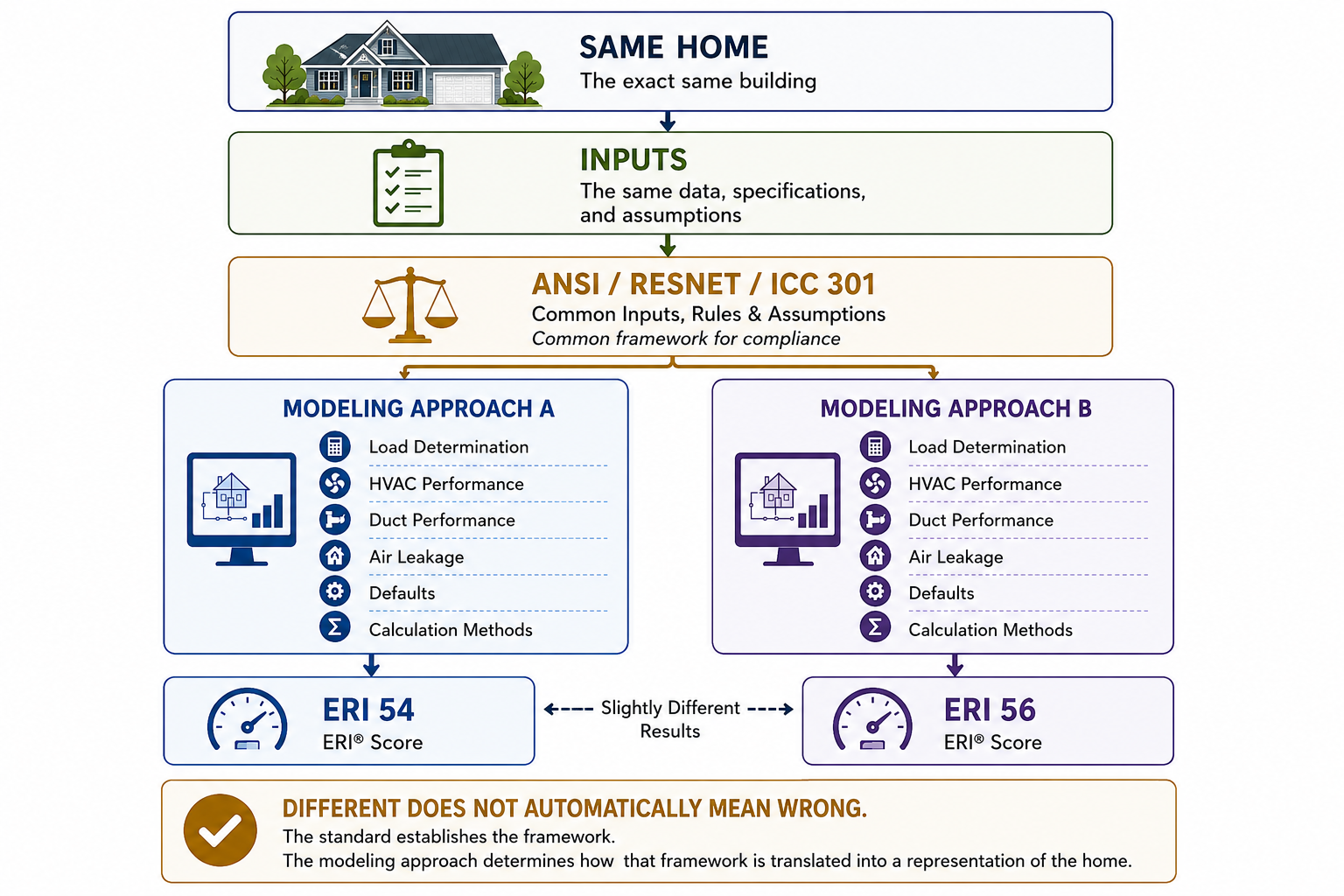
As a result, two software tools may represent the same home differently while still operating within the requirements of the same governing standard.
This does not automatically mean one model is wrong.
It often means the software has made different engineering decisions about how best to represent reality.
Standards Define the Framework
One of the most common misconceptions in residential energy modeling is that compliance with the same standard guarantees identical results.
Standards such as ANSI/RESNET/ICC 301 establish a common framework for modeling homes. They define required inputs, default assumptions, calculation procedures, and reporting requirements. This consistency is essential because it allows builders, raters, utilities, and program sponsors to compare homes using a common set of rules.
However, standards do not prescribe every aspect of how a building should be represented within a simulation engine.
At some point, software must translate those inputs into a physical model of how the home behaves throughout an entire year. That process requires engineering decisions about heat transfer, equipment performance, airflow, and countless other interactions that occur within a building.
Consider a home's duct system.
A standard may specify duct leakage, insulation levels, and location. Those inputs establish the characteristics of the system. The simulation engine must then determine how those ducts interact with the surrounding environment, how heat is gained or lost as conditioned air moves through the distribution system, and how those effects change throughout the year as operating conditions vary.
Two software tools may begin with the same duct specifications and still arrive at slightly different estimates of annual energy use because they represent those physical interactions differently.
Neither result is necessarily wrong.
Rather, each model reflects a different approach to representing the complex physics of a real building.
The Goal Is Consistency and Transparency
The industry's objective should not be to force every software tool to produce identical results under all circumstances.
Instead, the goal should be consistent implementation of standards, transparent assumptions, accurate representation of buildings, and ongoing validation and testing.
Healthy differences often lead to productive discussions that improve both software and standards over time.
If different energy modeling tools can produce different results, then understanding how those results are generated becomes increasingly important.
At Pivotal, we believe transparency is an important part of that conversation.
That's one reason our modeling platform is built on the open-source OpenStudio and EnergyPlus ecosystem. The underlying simulation methods, assumptions, and algorithms can be reviewed, discussed, and improved by the broader industry.
Open-source software does not eliminate differences between models, nor does it guarantee that every stakeholder will agree on every implementation decision. What it does provide is visibility into how those decisions are made.
We believe that visibility ultimately leads to better software, better standards, and more productive conversations across the industry.
Final Thoughts
When two energy models produce different results, it's natural to ask why.
The answer is rarely as simple as one model being right and another being wrong.
Understanding where differences come from—and recognizing the distinction between standards, inputs, and simulation engines—is often far more valuable than simply comparing outputs.
Because in building science, as in engineering generally, different does not automatically mean wrong.